
Innovationcode Design & Manufacturing

AI Leadership Transformation: Ascendants or Obsolete?

In the age of AI, businesses will increasingly fall into two categories: the Ascendants and the Obsolete.

That may sound dramatic, but the dividing line is already becoming visible.

For leaders, this is the central challenge of AI leadership transformation: turning technological capability into organizational advantage.

According to Stanford’s 2026 AI Index, 88% of surveyed organizations were using AI in at least one business function in 2025. Yet AI-agent deployment remained in the single digits across almost every business function.

That gap tells us something important.

Using AI is no longer a competitive advantage. Knowing what to do with it is.

The real competition will therefore not be between companies with AI and companies without AI. It will be between organizations that can continuously redesign themselves around new capabilities and organizations that cannot.

And behind those organizations, we increasingly see three types of leaders:

The Makers. The Watchers. The Blamers.

The Makers

Makers do not ask:

“How can we add AI to what we already do?”

They ask a much more uncomfortable question:

“If we created this company today, knowing what AI can do, would we still organize the work this way?”

That distinction is enormous.

A Maker may look at a process that requires ten people, five handovers and three days and discover that AI can reduce the information-processing part to twenty minutes.

But the objective is not simply cutting people.

The interesting question is what those people can now do with the time, intelligence and information suddenly available to them.

Makers redesign workflows.

They connect company knowledge.

They turn historical experience into reusable intelligence.

They automate repetitive reasoning while keeping human judgement where judgement actually creates value.

McKinsey’s research shows exactly why this matters. Although AI adoption has become widespread, only around one-third of surveyed organizations reported scaling their AI programs across the enterprise.

The bottleneck is increasingly not the model.

The bottleneck is the organization.

Organizations that want to lead this change must move beyond experimentation and become AI Makers rather than Watchers.

The Watchers

Watchers are more dangerous than they appear because they do not look conservative.

They attend conferences.

They subscribe to ChatGPT, Claude or Gemini.

They launch an AI committee.

They run pilots.

They ask consultants for presentations about “AI transformation.”

And then very little changes.

The organization continues producing quotations, engineering drawings, reports, purchasing decisions or project documentation essentially as it did five years ago — only now someone occasionally asks an LLM to write an email.

Watchers confuse exposure to technology with transformation.

They keep waiting for the technology to become more mature, more reliable, cheaper or easier to integrate.

But AI will never send them a message saying:

“The technology is now finished. You may safely begin.”

The companies moving fastest are learning while the technology is changing.

That learning compounds.

And compounded learning may eventually matter more than compounded capital.

The Blamers

Then come the Blamers.

They have explanations for everything.

AI hallucinates.

Our data is messy.

Our customers are different.

Engineering is too complex.

Our employees will resist.

Regulation is unclear.

Cybersecurity is a problem.

And, interestingly, many of those objections are perfectly legitimate.

That is precisely what makes the Blamer mindset so seductive.

The mistake is not identifying the risks.

The mistake is using the risks as justification for doing nothing.

A Maker sees an unreliable AI system and asks how to build verification around it.

A Blamer sees the same system and explains why AI cannot work.

Same technology.

Completely different trajectory.

From AI Tools to Organizational Intelligence

This distinction becomes particularly interesting in engineering.

Engineering companies accumulate enormous amounts of intelligence: CAD models, drawings, quotations, specifications, standards, calculations, supplier knowledge, previous design decisions and thousands of solutions to problems that somebody inside the organization has already solved.

Yet much of that intelligence remains fragmented.

AI changes the economics of accessing it.

This is one of the ideas behind AISON AE, the AI engineering environment we are developing.

The goal is not to build another chatbot.

It is to create an engineering intelligence layer capable of combining AI with company knowledge, historical projects and deterministic engineering tools.

Imagine an engineer analysing a new component.

Instead of starting from zero, an AI system can retrieve similar parts previously designed, associated 2D drawings, manufacturing decisions, quotations, technical documents and lessons learned.

AI proposes.

Company knowledge provides context.

Engineering rules verify.

The engineer decides.

That is a very different model from simply asking ChatGPT a question.

It turns years of accumulated experience into something closer to institutional memory that can actively participate in the work.

And that may become one of the most valuable assets a technical company can possess.

The Real Competitive Advantage

The World Economic Forum estimates that about 39% of workers’ existing skill sets will be transformed or become obsolete by 2030. At the same time, it expects analytical thinking, creativity, resilience, leadership and collaboration to remain critical alongside AI skills.

That combination is revealing.

The future is probably neither “humans versus AI” nor “AI replacing humans.”

It is organizations capable of combining machine intelligence, human judgement and proprietary knowledge better than their competitors.

The strongest companies will therefore not necessarily have the largest AI budgets.

They will have the shortest distance between knowledge and action.

They will learn faster.

Experiment faster.

Reuse knowledge faster.

Make decisions faster.

And improve their systems every time somebody completes a project.

Those are the Ascendants.

The Obsolete may still have good people, respected brands and profitable businesses.

Their problem is simply that the world around them will be learning faster than they are.

So perhaps every leadership team should stop asking:

“What should we do about AI?”

And ask something much more personal:

Are we Makers, Watchers or Blamers?

Because technology will continue to change.

The category we belong to is still a choice.

At Innovation Code, we help organizations move from AI experimentation to practical transformation by redesigning workflows, connecting knowledge, and turning AI into measurable business value. Learn more at www.innovationcode.com.
From AI Hype to Engineering Value: A Practical Guide

Artificial intelligence is moving through one of the most intense phases of technological expectation in recent history. AI agents, multimodal systems, foundation models, and AI-ready data are all presented as technologies capable of radically transforming business.

The shift from AI hype to engineering value

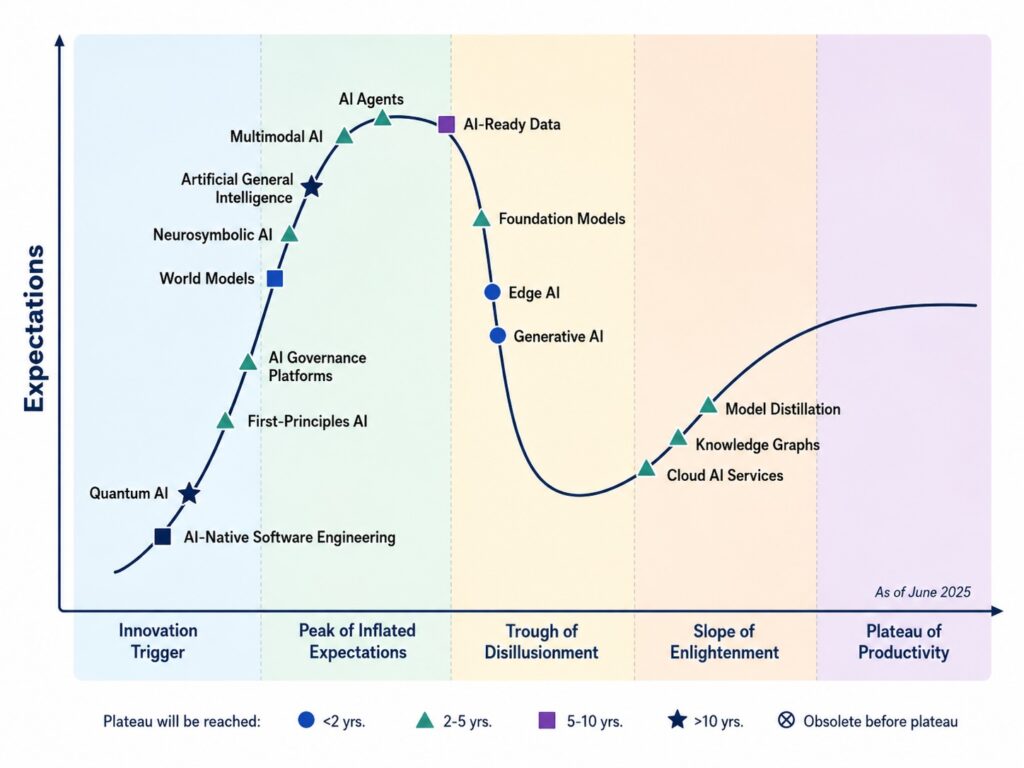
The hype-cycle curve helps us interpret this moment. It does not tell us which technologies are useful and which are worthless. Instead, it shows the distance that often exists between early enthusiasm and reliable industrial adoption.

This distinction is particularly important in engineering.

In product development, a convincing demonstration is not enough. An AI system must work with complex CAD models, technical drawings, customer specifications, manufacturing constraints, company standards, and regulatory requirements. It must also produce results that engineers can verify, trace, and trust.

The real opportunity, therefore, is not simply to “add AI” to CAD software. It is to create a new engineering operating model in which human designers collaborate with digital teammates capable of supporting complete workflows.

Why AI agents are approaching the peak of expectations

AI Hype to Engineering Value


Figure 1. The AI hype cycle—from early expectations to measurable engineering value.

AI agents differ from conventional software because they are not limited to executing a single predefined command.

An agent can receive an objective, break it into individual activities, collect information, use different applications, compare possible solutions, and prepare an output for human approval.

For example, a traditional CAD automation script might generate a family of components using fixed parameters. An engineering agent could potentially receive a customer request and then:

  • Retrieve similar projects from the company archive
  • Analyze the customer’s specifications
  • Identify missing or contradictory requirements
  • Open the relevant CAD models
  • Evaluate alternative configurations
  • Consult internal standards and design rules
  • Prepare a preliminary bill of materials
  • Highlight manufacturing and assembly risks
  • Generate a technical report for the designer

This is a major evolution. However, it is also the reason why AI agents are positioned close to the peak of inflated expectations.

Many companies imagine that an agent can immediately behave like an experienced engineer. In reality, the agent’s performance depends on the quality of the data, the clarity of the process, the reliability of its integrations and the rules governing its autonomy.

A digital teammate without access to structured engineering knowledge is not an engineer. It is a powerful reasoning system operating with incomplete information.

AI-ready data is the real foundation

The position of AI-ready data near AI agents in the curve contains an important message.

Agents cannot deliver reliable results if engineering information is fragmented across disconnected systems.

In many companies, the 3D model is stored in a PDM system, the drawing is saved somewhere else, the calculation report exists as a PDF, manufacturing feedback remains in emails, and important design decisions are known only by a few senior engineers.

This may be manageable for experienced employees, but it is extremely difficult for an AI system.

To make engineering data AI-ready, companies must connect and structure information such as:

  • CAD models and their revisions
  • 2D drawings and tolerances
  • Product configurations
  • Bills of materials
  • Materials and treatments
  • Design standards
  • Calculation reports
  • Non-conformities and corrective actions
  • Manufacturing feedback
  • Lessons learned from previous projects

The objective is not to place every document inside a single database. It is to create a reliable knowledge architecture through which the AI can understand which information is current, which revision is valid, and how different technical objects are related.

This is where PDM, PLM, knowledge graphs and retrieval systems become essential components of the AI strategy.

CAD will become an environment for collaboration, not merely modeling

CAD systems have already evolved from electronic drawing boards into sophisticated product-development platforms. The next step will be their transformation into collaborative environments shared by designers and AI agents.

The agent will not necessarily replace the engineer at the workstation. It will operate around the CAD system, performing activities that currently consume large amounts of engineering time.

A digital teammate could verify whether a model respects company modeling standards, identify missing metadata, compare geometries across revisions, or check whether standard components have been reused correctly.

It could also analyze design intent.

Two components may look geometrically similar but have completely different functional requirements. An intelligent system should not merely recognize shapes. It must understand the relationships between function, geometry, material, tolerance, and manufacturing process.

This is where multimodal AI becomes especially relevant. Engineering knowledge is rarely contained in text alone. It is distributed across 3D geometry, drawings, tables, diagrams, photographs, simulation results and written specifications.

A useful engineering agent must be able to work across all these formats.

From CAD automation to engineering delegation

Companies have automated CAD activities for decades through macros, templates, configurators and application programming interfaces. These solutions remain valuable, but they normally require predictable inputs and predefined logic.

 AI agents introduce a different concept: engineering delegation.

Instead of programming every individual step, the company defines an objective, constraints, and approval rules.

Consider the creation of a manufacturing drawing.

Traditional automation can generate predefined views and dimensions. A more advanced agent could analyze the part’s function and manufacturing process, identify the critical features, retrieve the applicable drawing standard, propose dimensions and tolerances, and highlight uncertain decisions for review.

The engineer would not disappear from the process. The engineer’s role would move from manually producing every element to supervising, correcting, and approving a technically informed proposal.

The same principle could apply to:

  • Design reviews
  • Drawing verification
  • Tolerance analysis
  • Component classification
  • Standard-part selection
  • Engineering change requests
  • Quotation preparation
  • Technical documentation
  • Design-for-manufacturing checks

The value is not merely faster modeling. It is the reduction of repetitive coordination around modeling.

Why generic AI will not be enough

A general-purpose AI model may understand engineering language, but it does not automatically understand how a particular company designs its products.

Every organization has its own standards, preferred solutions, risk tolerances, customer requirements, and accumulated experience.

This means that the most valuable engineering agents will not be generic assistants. They will be connected to company-specific knowledge.

An agent working in packaging machinery should understand machine modules, line speeds, format changes, safety constraints and hygienic design. An agent supporting medical-device development must work within a very different environment involving validation, risk management, traceability and regulatory controls.

Competitive advantage will not come only from access to the most powerful foundation model. Most companies will eventually have access to comparable models.

The advantage will come from combining those models with proprietary engineering data, well-designed workflows and specialist expertise.

Human accountability remains essential

Engineering decisions affect cost, performance, reliability and safety. Therefore, autonomy must always be proportional to risk.

An AI agent may be allowed to classify components, prepare reports or suggest design alternatives autonomously. It should not necessarily be authorized to release a drawing, change a safety-critical tolerance or approve a product configuration without human validation.

AISON AE provides practical guidance for managing AI risks and incorporating trustworthiness into AI systems.

Every agent should have a clearly defined role:

  • What outcome is it responsible for?
  • Which systems can it access?
  • Which decisions can it make?
  • When must it request approval?
  • How is its performance measured?
  • Who is accountable for its output?

The key question is not whether an AI agent can perform an activity.

The key question is under which technical and organizational conditions it should be permitted to perform it.

This is the difference between uncontrolled automation and industrial-grade AI.

The trough of disillusionment will eliminate weak projects

Many AI initiatives will fail after the current phase of enthusiasm.

Some companies will discover that their data are unusable. Others will automate processes that were poorly designed from the beginning. Some will purchase attractive tools that cannot integrate with their CAD, PDM or PLM environments.

This period of disillusionment is not necessarily negative. It will separate demonstrations from real engineering solutions.

Successful projects will normally start from a specific business problem: reducing drawing lead time, improving quotation accuracy, reusing previous designs, detecting design errors earlier, or preserving expert knowledge.

They will also measure concrete results rather than generic “AI adoption”: hours saved, rework avoided, errors detected, development time reduced, and knowledge recovered.

Turning the hype cycle into an engineering roadmap

The chart should not discourage investment in AI agents. It should encourage disciplined investment.

Engineering companies should begin with limited but valuable responsibilities, connect agents to reliable information and maintain human control over high-impact decisions.

The objective is not to create an artificial engineer overnight. It is to progressively build digital teammates that can understand the company’s products, support its designers and improve the continuity of its engineering processes.

The companies that succeed will not be those that experiment with the largest number of AI tools. They will be those that transform their CAD data, engineering knowledge and workflows into an intelligent operating system for product development.

About Innovation Code

Innovation Code is a Thai-Italian engineering and AI company that helps industrial companies bring products to market faster. By combining European engineering expertise, AI-powered development and Asian manufacturing capabilities, we turn ideas into mechanical designs, animated 3D concepts, prototypes and production-ready solutions.

Discover how Innovation Code can help your team accelerate product development and move from concept to production: www.innovationcode.com