
AI Winners Don’t Just Talk about AI
Over the past few years, artificial intelligence has become one of the most discussed topics in the business world. Almost every company claims it is investing in AI. Many launch pilot projects, establish innovation labs, or create dedicated AI leadership roles.
Yet there is a significant difference between talking about artificial intelligence and genuinely transforming an organization through AI.
The most advanced companies do not use AI simply to showcase their technological sophistication. They do not adopt new solutions just because they are innovative, nor do they fill presentations with buzzwords such as machine learning, digital twins, agentic AI, or generative design without a clear business purpose.
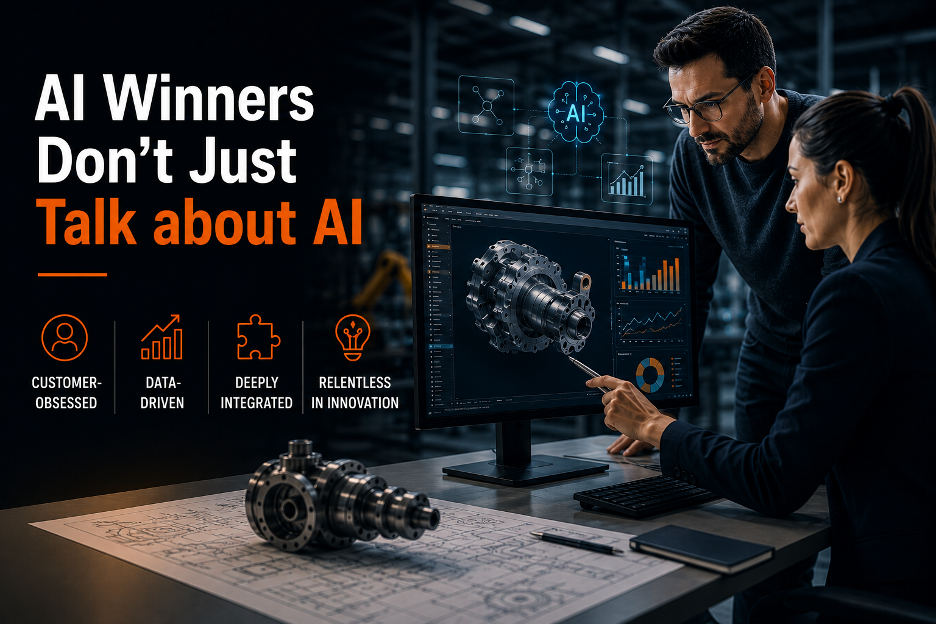
Instead, organizations that achieve measurable results share four fundamental characteristics:
- They are customer-obsessed.
- They are data-driven.
- They are deeply integrated.
- They are relentless in pursuing innovation.
These four principles transform artificial intelligence from an interesting technology into a true competitive advantage.
1. Be Customer-Obsessed: Start with the Problem, Not the Technology
The most successful companies do not begin by asking:
“Where can we use artificial intelligence?”
Instead, they ask much more practical questions:
- What is the biggest problem our customers are trying to solve?
- Where do they lose the most time?
- Which activities create unnecessary costs, risks, or frustration?
- How can we deliver a faster, better, or more personalized experience?
This difference in mindset is critical.
When organizations start with technology, they often build technically impressive solutions that provide little real business value. The result is a collection of sophisticated demonstrations, proof-of-concepts, and pilot projects that never progress into everyday operations.
When they start with a genuine customer problem, AI becomes a practical tool for creating measurable value.
In manufacturing, for example, AI can help:
- Reduce engineering and design time.
- Detect potential errors before they become costly problems.
- Automate repetitive engineering tasks.
- Improve product quality.
- Accelerate the creation of technical documentation.
The true value is not the algorithm itself.
The value lies in delivering faster quotations to customers, allowing engineers to spend less time on administrative work, enabling production managers to identify issues before they cause downtime, and reducing engineering changes after production has begun.
Being customer-obsessed means using artificial intelligence to solve real problems and create tangible business value.
It also means involving customers throughout the development process. Their feedback, working habits, and operational challenges become essential inputs for innovation.
The most effective AI solutions are not developed in isolation inside technology labs.
They emerge from the continuous collaboration between technology, engineering expertise, and real market needs.
2. Be Data-Driven: Build a Continuous Cycle of Improvement
Artificial intelligence depends on data. But having large amounts of data does not automatically make a company data-driven.
In many organizations, information is scattered across different departments, stored in incompatible formats, or trapped inside systems that do not communicate with one another.
Engineering data may reside in CAD or PLM systems, production information in the MES, orders in the ERP, customer information in the CRM, and valuable technical knowledge across thousands of documents, emails, reports, manuals, and personal files.
The result is a company with an enormous amount of information—but limited ability to fully utilize it.
Truly data-driven organizations transform this information into a continuous cycle of improvement.
Every customer interaction, every completed project, every engineering change, every resolved issue, and every business decision contributes to making products, processes, and services smarter.
Imagine an AI system designed to support mechanical engineering.
Initially, it may provide recommendations based on engineering standards, design rules, and previous projects. As engineers review and refine those recommendations, every correction can be captured and used to improve future suggestions.
The more the system is used, the more it learns.
The more it learns, the more valuable it becomes.
The more valuable it becomes, the more people rely on it.
This is the true competitive advantage of data: the ability to create a self-reinforcing cycle of continuous improvement that becomes increasingly difficult for competitors to replicate.
Achieving this, however, requires far more than installing new software.
Organizations need a clear data strategy. They must decide which information should be collected, ensure data quality, establish consistent classification standards, and make organizational knowledge accessible to both people and AI systems that depend on it.
Equally important is maintaining human oversight.
In complex fields such as engineering, product development, and industrial manufacturing, historical data should never replace expert judgment—it should strengthen it.
The objective is not to eliminate engineering expertise.
The objective is to empower specialists to make faster, better-informed, and more consistent decisions.
3. Be Integrated: AI Cannot Remain Confined to a Single Department
One of the most common mistakes organizations make is treating artificial intelligence as a standalone initiative, separate from the rest of the business.
A dedicated AI team is formed, a handful of experimental applications are developed, and the company waits for innovation to spread naturally throughout the organization.
In most cases, it never does.
AI creates real value only when it is embedded into the everyday processes and tools that people already use.
For engineers, AI should be available directly within their CAD, PLM, or simulation workflows. For production managers, it should integrate seamlessly with MES, ERP, and quality management systems. For sales teams, it should connect with CRM platforms, technical data, and the quotation process.
Artificial intelligence should not be viewed as a separate department—it should become a capability that spans the entire organization.
This means every business function should understand three key things:
- What business problems AI can solve.
- What data AI requires to deliver reliable results.
- How existing processes need to evolve to unlock AI’s full potential.
The IT department continues to play a critical role, but it cannot be solely responsible for the organization’s AI transformation.
Engineers must define the technical rules and engineering logic. Production managers need to provide insight into real operating conditions. Quality teams should establish validation and verification criteria. Leadership must set strategic priorities. And end users should evaluate whether AI solutions are practical, reliable, and truly improve their work.
Successful integration is therefore both technological and organizational.
From a technological perspective, it means connecting data, software, and digital infrastructure into a unified ecosystem.
From an organizational perspective, it means breaking down silos and building cross-functional teams that combine engineering expertise, process knowledge, and digital capabilities.
AI becomes a true strategic asset only when it is no longer seen as something separate from daily work.
Instead, it becomes a natural part of how the organization designs products, manages operations, makes decisions, and serves its customers.
4. Be Relentless: Innovate Without Losing Speed or Focus
Leading companies do not view innovation as a project with a defined beginning and end. Instead, they operate in a continuous cycle of experimentation, learning, and improvement.
This does not mean chasing every new technology trend. It means developing the ability to constantly observe change, test new ideas quickly, and turn the most promising ones into practical business solutions.
Traditional organizations often slow innovation through lengthy decision-making processes, rigid procedures, and a strong fear of failure.
The most successful companies take a different approach. They maintain the agility of a startup by working with small teams, clear objectives, short development cycles, and continuous feedback from users.
They move fast—but not carelessly.
They measure results.
They eliminate what doesn’t work.
They improve what creates value.
And they gradually scale the solutions that demonstrate measurable business impact.
This approach is particularly important in artificial intelligence, where models, platforms, and applications evolve at an extraordinary pace.
A project designed today may need to be revised within six months. A solution considered state-of-the-art today may quickly become outdated. At the same time, technologies that initially seemed immature can suddenly become practical for industrial-scale deployment.
For this reason, organizations should not simply invest in AI technology.
They must build the capability to adapt.
Being relentless also means recognizing that AI transformation will not be perfect from day one.
An initial solution may automate only 50–60% of a process. It may still require human validation or be suitable only for a specific product category.
That does not make it a failure.
Instead, it represents the first step in a continuous learning journey, where performance improves through experience, user feedback, and the availability of more high-quality data.
From Experimentation to Organizational Capability
Customer obsession, data, integration, and continuous innovation are not four separate initiatives.
They are four interconnected elements of a single system.
A customer-focused mindset identifies the problems worth solving.
Data enables AI systems to learn and improve over time.
Integration embeds AI into everyday business processes.
Continuous innovation ensures the organization remains adaptable and ready to seize new opportunities.
When these four elements work together, artificial intelligence stops being just another collection of tools.
It becomes a core organizational capability.
That is the real turning point.
The most competitive companies of the future will not necessarily be those using the most powerful AI model or the most expensive platform.
They will be the organizations that combine technology, data, engineering expertise, and customer knowledge more effectively than anyone else.
They will not be recognized by the number of AI projects they launch.
They will be recognized by the value those projects create.
They will not use artificial intelligence simply to impress the market.
They will use it to design better products, manufacture more efficiently, reduce errors, create new services, and respond to customer needs with greater speed and precision.
Engineering Is at the Heart of AI Transformation
For manufacturing companies, AI transformation cannot be separated from engineering.
Many of the greatest opportunities lie within the product development lifecycle—from engineering design and simulation to requirements management, industrialization, technical documentation, engineering change management, and production support.
Unlocking these opportunities requires more than expertise in digital technologies.
It requires a deep understanding of real industrial processes.
At Innovation Code, we help industrial companies turn AI opportunities into practical improvements across engineering, product development, manufacturing, and digital growth.
Our Thai-Italian team combines more than 18 years of engineering experience with AI-enabled methods and hands-on industrial execution in Asia.
Because the true objective is not to introduce more AI into your organization.
It is to create better products, more efficient processes, and lasting value for your customers.
Ready to explore where AI can create the greatest impact in your business?
Contact Innovation Code to assess your engineering and development processes and identify the AI applications with the strongest technical and commercial potential. Visit www.innovationcode.com or email info@innovationcode.com.om.