
AI Implementation Strategy: Build on Solid Ground
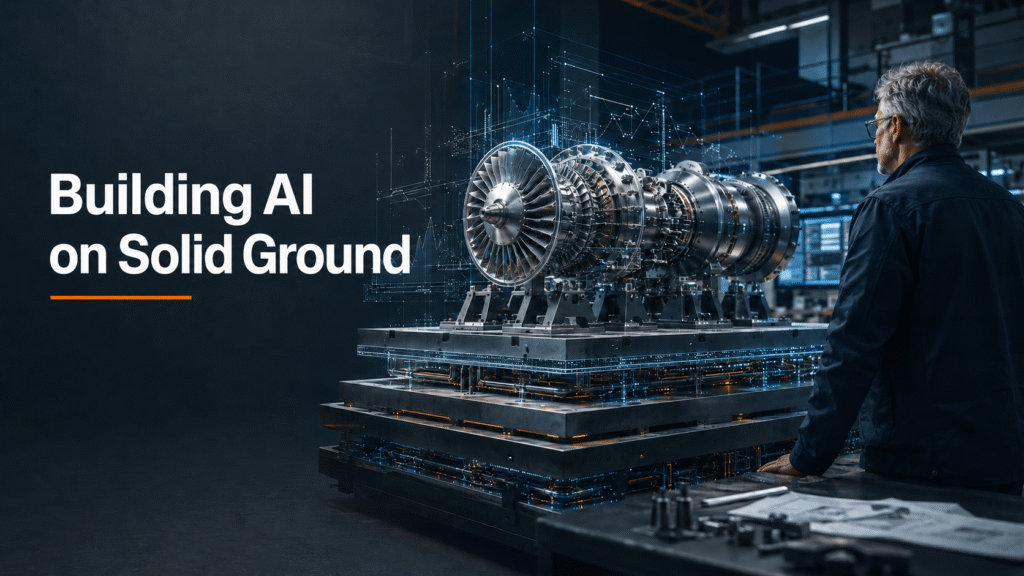
Why Companies Must Fix the Foundations Before Chasing Innovation
Reliable enterprise AI begins with the business problem—not the model. Strong data, architecture, testing, and human control turn promising pilots into scalable operational systems.
Artificial intelligence is becoming a business imperative
Executives want AI roadmaps. Departments are testing generative AI tools. Boards are asking when AI will reduce costs, improve productivity, accelerate innovation and create new revenue.
The urgency is understandable. AI is already changing how companies design products, analyze information, manage knowledge, automate repetitive work and support decisions. Yet many organizations are moving too quickly from enthusiasm to implementation.
They are trying to build a skyscraper on unstable ground. The result is often an impressive demonstration that never becomes a reliable industrial solution. A chatbot works during a presentation but fails on complex technical questions. A model produces plausible answers but cannot retrieve the correct company data. An automation saves time in one department while creating risk and manual checks elsewhere.
The AI model is not always the problem. More often, the weakness lies in the business process, data, system architecture, testing, governance or ownership surrounding it.
AI is not a product you simply install
Enterprise AI is not a standalone office tool. It must work with business processes, people, data, software, security rules and decision responsibilities.
This is especially important in engineering and manufacturing. A generic assistant may draft an email or summarise a public document. An operational engineering AI system must work with product specifications, CAD-related information, technical standards, manufacturing constraints, previous projects, customer requirements and the language used by experienced engineers.
The difference between a demonstration and an operational system is the ability to deliver consistent, traceable, secure and business-relevant results. That requires five strong foundations.
1. Start with the business problem
Many AI initiatives begin with the wrong question: “How can we use AI?”
A better question is: “Which business problem should we solve, and is AI the right tool?” Technology should follow the objective.
A manufacturer may need to reduce quotation time. An engineering team may need to reuse knowledge from previous projects. A product-development group may want to accelerate technical documentation. Each objective requires a different solution and a different measure of success.
Some problems are suited to a large language model. Others require computer vision, machine learning, deterministic software, engineering rules, CAD automation—or a combination. In practice, the most dependable solution is often a hybrid architecture in which AI works with verified data, rules and human expertise.
A serious AI implementation therefore begins with process analysis: where time is lost, where errors occur, which decisions repeat, which information is difficult to retrieve and which activities depend too heavily on individual experience.
2. Make data usable—not merely available
Companies often possess large volumes of information: drawings, spreadsheets, reports, emails, specifications, manuals, project archives and production records. But having data is not the same as having usable data.
Information may be distributed across systems, duplicated, incomplete, poorly classified or accessible only to a few specialists. AI does not automatically repair these weaknesses; it can amplify them, while presenting an incorrect answer with confidence.
Before implementation, the organization must establish:
- what information exists and where it is stored;
- who owns it and keeps it current;
- whether it is accurate, complete and consistently classified;
- which users are authorised to access it; and
- how the system will retrieve and cite the correct source.
Retrieval-Augmented Generation (RAG) can be valuable because it retrieves approved corporate information before generating an answer. But RAG is not simply a matter of uploading thousands of files. Content must be selected, prepared, segmented, indexed, enriched with metadata, tested and maintained. Retrieval quality is often more important than the apparent intelligence of the language model.
3. Design architecture for change and scale
A small pilot can be built quickly. A system that remains secure and reliable as usage grows is much harder.
Companies must decide how AI will interact with databases, cloud services, engineering platforms and cybersecurity policies. Will the solution run in the cloud, on premises or in a hybrid environment? Can it connect to ERP, PLM, CRM, CAD, document-management and production systems? How will permissions, logging, monitoring and model changes be handled?
These are business questions as much as technical ones because they determine cost, security, performance and long-term flexibility.
A robust architecture separates the business logic, data layer, interface, AI model and integrations. This modular structure reduces vendor lock-in, allows individual components to evolve and makes it possible to expand from one focused use case without rebuilding the entire platform.
4. Test AI outputs systematically
A few successful questions do not prove that an AI application is ready for operational use. Structured testing is essential, particularly in engineering, manufacturing, quality, compliance and customer-facing environments.
Organisations can strengthen this process by using a structured AI risk management framework, such as the NIST AI RMF, to identify, assess and manage risks throughout the design, development, deployment and evaluation of AI systems.
Test cases should cover normal requests, complex situations, ambiguous language, incomplete data, specialist terminology and potentially harmful outputs. Performance should be assessed against defined criteria:
- accuracy and completeness;
- source traceability and response consistency;
- execution time and failure rate;
- user satisfaction; and
- measurable business impact.
The objective is not to prove that the system is perfect. It is to understand where it performs well, where human verification is mandatory, and where AI should not be used. This is how an experiment becomes a controlled business capability.
5. Keep people inside the architecture
AI transformation changes how people work. Employees may fear replacement, managers may expect too much and experienced specialists may distrust a system that appears to simplify knowledge developed over decades.
Teams need clarity about how the system supports their work, which decisions remain human, how outputs must be verified and how feedback will improve the solution.
The best systems do not remove expertise; they make it more accessible, reusable and scalable. An engineer can spend less time searching previous projects and more time solving difficult design problems. A project manager can reduce administration and focus on risk, coordination and customer communication.
The goal is not to eliminate human intelligence. It is to create a stronger working relationship between human judgement and machine capability.
From AI enthusiasm to AI engineering
The next phase of AI will not be led by the companies that launch the most pilots. It will be led by those that convert the right experiments into reliable operational capabilities.
That requires business analysis, process knowledge, software architecture, data engineering, integration, testing, governance and a realistic understanding of how people work.
The challenge is particularly demanding in product design and development, where knowledge is distributed across drawings, specifications, calculations, standards, supplier information, manufacturing experience and the judgment of individual engineers.
The Innovation Code approach
At Innovation Code, we treat artificial intelligence as a practical engineering and business challenge—not a marketing trend.
As a Thai-Italian engineering and AI company, we combine European engineering expertise, AI-powered development and Asian manufacturing capabilities. This experience helps us identify where AI can create practical value across real product-development and industrial workflows.
We help industrial companies assess AI opportunities, improve knowledge access, automate repetitive workflows and introduce AI where it can support faster, better-controlled decisions. We begin with the process and the business objective, then define the right combination of AI, software, data and human expertise.
Our objective is not to add AI everywhere. It is to apply the right technology to the right problem while preserving engineering judgement, traceability and human control.
Before building the skyscraper, we make sure the ground can support it.
Build AI for engineering on solid foundations
AI can help engineering teams work faster, reuse technical knowledge, reduce repetitive tasks, improve decisions and accelerate product innovation—but only when its foundations are designed correctly.
For companies ready to move from AI interest to practical implementation, Innovation Code helps identify valuable use cases, structure an AI implementation strategy and connect digital tools with real engineering and product-development workflows. For a dedicated industrial engineering AI platform, explore AISON AE, which helps engineering teams reuse technical knowledge, support technical decisions and reduce repetitive documentation while keeping engineering judgment at the center. Contact Innovation Code to discuss where AI can create measurable value in your organization.