From Hierarchy to Intelligence
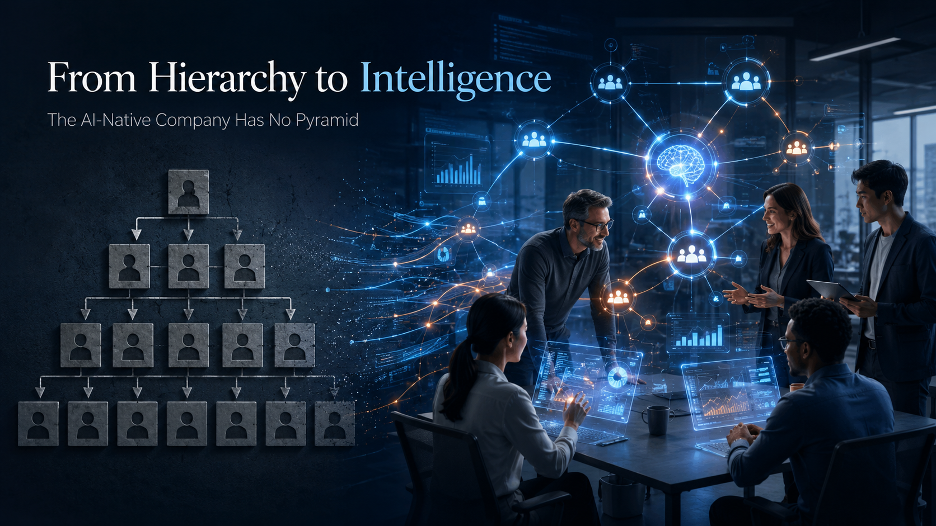
The AI-Native Company Has No Pyramid
For more than a century, companies have been designed as pyramids.
A small group of executives sits at the top, employees operate at the bottom, and multiple layers of management connect the two. Information moves upward, decisions move downward, and each function protects its own responsibilities, budgets and priorities.
This structure was not irrational. It was built for an industrial world in which information was difficult to collect, communication was slow, expertise was concentrated and coordination required direct supervision.
But that world is disappearing.
In an AI-powered organization, information is no longer scarce. It can be collected, analyzed, summarized and distributed almost instantly. Employees can access knowledge that was previously controlled by managers, specialists or entire departments. Routine coordination can increasingly be handled by intelligent systems, while operational problems can be identified before they reach senior leadership.
The traditional pyramid is therefore becoming more than inefficient. It is becoming a strategic liability.
Why Middle Management Is Being Redefined
The problem is not that middle managers are unnecessary. The problem is that many traditional middle-management activities are becoming unnecessary.
Historically, managers were expected to collect updates, monitor execution, prepare reports, distribute instructions, schedule meetings and ensure that information moved between organizational layers.
AI can now perform much of this work faster and more consistently.
It can produce real-time performance reports, track project progress, identify delays, summarize meetings, compare results with targets and make relevant information available to everyone involved.
This reduces the value of management as an information relay.
The future manager will not be paid primarily to move information through the organization. Managers will create value by interpreting complexity, resolving ambiguity, developing people, connecting capabilities and improving the quality of decisions.
In other words, management will move from supervision to orchestration.
From Functional Silos to Mission-Based Teams
Traditional organizations are divided into functions: engineering, marketing, finance, operations, sales and human resources.
This creates specialization, but it also creates distance.
Problems move from one department to another. Decisions require multiple approvals. Teams optimize their own objectives rather than the overall outcome. Customers experience the company as a fragmented system, even when the organizational chart appears efficient internally.
The AI-era organization requires a different structure: small, multidisciplinary teams built around missions, products, customers or business outcomes.
A team responsible for launching a new industrial product, for example, may include engineering, manufacturing, procurement, commercial and data expertise. Instead of sending work sequentially across departments, the team works on the problem simultaneously.
AI-enabled engineering platforms can become part of the team’s operating infrastructure, supporting research, analysis, technical documentation, knowledge retrieval and better decision-making.
The Organization as a Network
The emerging organizational model is not a flatter pyramid. It is a network.
In a network organization, authority is distributed according to competence and context rather than permanently attached to hierarchical position.
Leadership becomes dynamic.
The person leading a technical decision may not be the person leading a customer negotiation. The employee with the best knowledge of a specific problem may temporarily become the most important decision-maker in the system.
This does not mean eliminating structure or accountability. A completely decentralized organization can easily become chaotic.
The objective is not to remove leadership. It is to separate leadership from bureaucracy.
Senior executives remain responsible for direction, capital allocation, governance and strategic priorities. However, teams closer to the problem receive greater authority to make operational decisions within clearly defined boundaries.
The company becomes centrally aligned but locally autonomous.
AI Does Not Remove Hierarchy. It Changes Its Purpose.
Predictions about the “end of management” are exaggerated.
Organizations still need responsibility, standards, coordination and final decision rights. AI cannot carry legal accountability, understand every cultural nuance or replace human judgment in situations involving uncertainty, ethics and conflicting interests.
However, AI changes what hierarchy is for.
Hierarchy should no longer exist to compensate for poor information flow. It should exist to provide direction, clarify accountability and resolve conflicts that cannot be solved locally.
Every organizational layer must therefore answer a simple question:
What unique decision or capability does this layer provide?
When a layer mainly collects information, reformats reports or approves decisions that could safely be made elsewhere, its value should be questioned.
The goal is not indiscriminate downsizing. It is organizational redesign.
The Rise of the AI-Enabled Employee
One of the most significant effects of AI is the expansion of individual capability.
A single employee can now research markets, analyze data, generate presentations, review contracts, create prototypes, document processes and coordinate projects with a level of speed that previously required several people.
This does not mean every employee becomes an expert in every field. It means the boundary between roles becomes more flexible.
The future employee will increasingly operate as a problem owner rather than a narrow task executor.
This requires companies to rethink job descriptions, performance measurement and career development. Employees should be rewarded not only for completing assigned tasks, but also for improving systems, solving cross-functional problems and creating measurable outcomes.
The most valuable people will not necessarily be those who control the most resources. They will be those who can combine domain expertise, AI capabilities and organizational influence.
A New Role for Corporate Functions
Functions will not disappear, but their role will change.
Instead of controlling every activity, central functions will increasingly operate as capability platforms.
Human resources will provide talent systems, organizational design and workforce intelligence. Finance will provide real-time economic visibility and decision support. IT will provide secure digital and AI infrastructure. Engineering leadership will define technical standards, reusable knowledge and specialist communities.
These functions will support mission-based teams without becoming permanent bottlenecks.
Their success will be measured by how effectively they enable the rest of the organization, not by how many approvals they control.
The Real Competitive Advantage
AI technology will eventually become widely accessible. Most companies will have access to similar models, platforms and automation tools.
The real competitive advantage will come from organizational architecture.
Companies that preserve slow decision chains, rigid roles and defensive silos will use powerful AI inside an outdated system. They may automate individual tasks without improving the organization as a whole.
Companies that redesign around speed, transparency, autonomy and shared intelligence will achieve something more important: organizational leverage.
They will make better decisions with fewer layers, move from idea to execution more quickly and allow talented people to contribute beyond the boundaries of their formal positions.
The companies of the future will not be defined by the size of their pyramids.
They will be defined by the intelligence of their networks.